
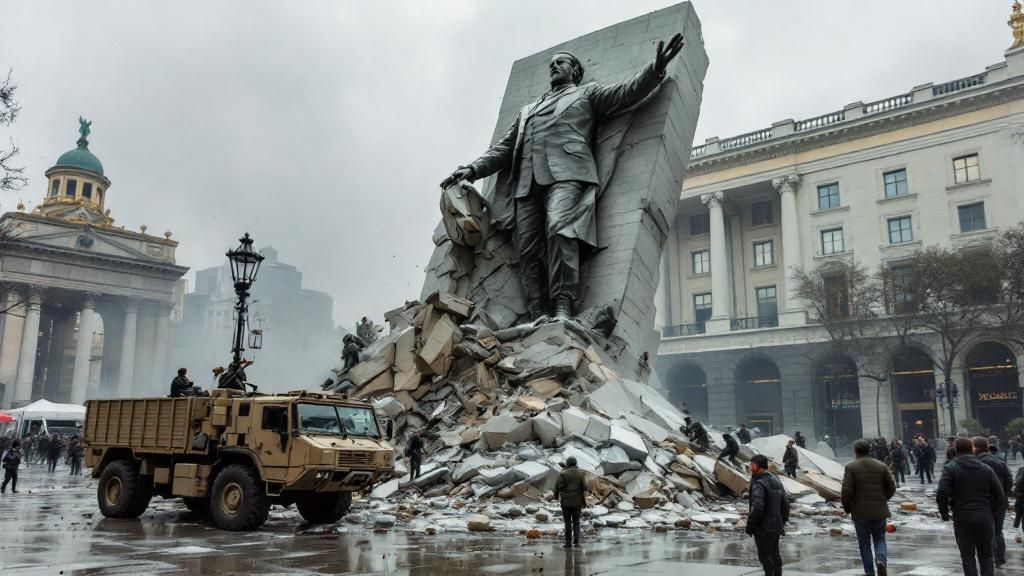
The collapse of Saddam Hussein’s statue in Baghdad on 9 April 2003 emerged as an enduring symbol of American military triumph, yet it signalled the commencement of a disaster that would fundamentally alter the Middle East for decades to come. Three weeks subsequently, President George W Bush proclaimed “Mission Accomplished” aboard an naval vessel off California, but the subsequent two decades demonstrated the falseness of that boast. The Iraq invasion, commenced just 20 days before the statue fell, eventually resulted in an estimated 461,000 lives, consumed the United States $3 trillion, and triggered a cascade of unforeseen consequences that continue to reverberate today. Now, as America engages with Iran, the spectre of Iraq’s downfall weighs heavily, pushing policymakers to address challenging questions about whether the mistakes of 2003 can be avoided.
A Banner That Offered Too Much
The decision to invade Iraq in 2003 rested on a foundation of multiple, sometimes contradictory rationales that varied according to the listener. The Bush administration main goal was overthrowing the regime—the ousting of Saddam Hussein from office. For some within the administration, this constituted outstanding matters from the 1991 Gulf War, when Hussein had been expelled from Kuwait but permitted to stay in charge of Iraq. Others, such as the President himself, harboured more personal reasons; Hussein had allegedly planned to kill George HW Bush, the former president and George W Bush’s parent, after the earlier conflict. These layered grievances gave the political impetus for military action.
Beyond the political calculations, proponents of invasion also advanced humanitarian arguments, contending that regime change was ethically defensible given Hussein’s well-documented cruelty towards his own population. The Iraqi leader’s chemical weapons attacks against Kurdish civilians in the 1980s constituted a key element of this argument. Yet these differing justifications—some publicly articulated, others quietly acknowledged only within government circles—would later prove deeply problematic when the anticipated rapid success gave way to prolonged occupation, sectarian violence, and regional instability. The intricate web of stated reasons masked the lack of a coherent post-invasion strategy.
- Governmental overthrow as main goal and long-standing American aim
- Outstanding matters from the 1991 Gulf War remaining unresolved
- Individual incentives tied to purported assassination attempt against Bush senior
- Humanitarian concerns concerning Hussein’s established chemical weapons programmes
The Intricate System of Justifications
Iraq’s Disputed Objectives
The military incursion into Iraq was never presented to the public as a direct assertion of dominance, despite regime change constituting Washington’s primary objective. Instead, the Bush government constructed an complex account centred on weapons of mass destruction—claims that subsequently turned out to be unfounded and deeply damaging to American credibility. Intelligence agencies, both American and British, maintained with seeming confidence that Hussein held active programmes for chemical and biological weapons. These claims dominated public discourse and provided the legal and moral justification for military intervention that appealed to domestic audiences and international allies alike.
What emerged only incrementally was the complete scope to which ideological considerations had influenced decision-making within the government. Neoconservative thinkers around President Bush envisioned Iraq as merely the first step in a wider reshaping of regional politics. They contended that toppling Hussein would trigger a cascade of democratic transformations across the region. This utopian vision, paired with the more parochial interests of energy firms and defense firms, created a strong alliance supporting invasion. The multiple layers of justification meant that when the primary rationale—weapons of mass destruction—disappeared, the entire intellectual foundation for the war crumbled.
Iran Through a Different Lens
The present standoff with Iran operates within a markedly different strategic landscape, shaped fundamentally by Iraq’s cautionary lessons. The Trump administration’s exit from the atomic agreement and following “maximum pressure” initiative against Tehran relied less on invented intelligence reports and more on direct strategic rivalry. Rather than creating a pretext for regime change, American policy has concentrated on restricting Iran’s regional reach and stopping nuclear weapons spread. This represents a significant tactical shift, though critics contend it continues to be equally destabilising. The administration’s language stressed containment rather than transformation, implying policymakers had retained at least some lessons from Iraq’s missteps.
Yet parallels persist troubling. Hardline figures in governmental circles have consistently pushed for increasingly forceful action, echoing the hawkish strategy of 2003. The assassination of General Qasem Soleimani in January 2020 demonstrated how rapidly rhetoric can translate into kinetic action. However, the international response differed markedly from 2003—few allies rallied to Washington’s side, and public scepticism proved considerably stronger. The Iraq experience had substantially changed the political calculus, making another large-scale military intervention considerably harder to defend at home and abroad, even as tensions with Iran periodically threatened to exceed containment.
- Iraq’s WMD claims proved to be fabricated, damaging American intelligence credibility worldwide
- Iran strategy emphasises deterrence over explicit regime change objectives
- Neoconservative vision of democratic dominoes did not materialise in Middle East
- Public scepticism about military intervention significantly grew following Iraq across Western nations
- International coalition building far more difficult without credible intelligence justifications
Britain’s Shifting Part in American Wars
Britain’s participation in the Iraq invasion represented the closest military alignment between London and Washington since the Second World War. Prime Minister Tony Blair sent British forces to what would become a bitterly divisive conflict, ultimately committing over 46,000 troops at the campaign’s peak. The decision was made in part due to intelligence assessments that subsequently proved deeply inaccurate, notably with respect to weapons of mass destruction. Blair’s support for Bush’s invasion produced lasting political consequences in Britain, undermining public trust in government and sparking a peace movement of unprecedented scale. The Chilcot Inquiry, published in 2016, would eventually issue a devastating verdict on the process of decision-making.
The Iraq involvement fundamentally altered Britain’s strategy to American armed interventions in the Middle East. When tensions mounted with Iran, British policymakers showed considerably more restraint about engaging in American operations. The government maintained its “special relationship” with Washington whilst simultaneously moving away from the most aggressive postures towards Tehran. This demonstrated more than shifting political assessments but a fundamental transformation in how British officials evaluated the risks and benefits of military intervention. The memory of Iraq cast a shadow on every subsequent decision regarding Middle Eastern conflicts, leaving policymakers acutely aware of the home political consequences of backing another controversial American war.
The Price of Proximity
British service personnel incurred substantial losses for their proximity to American decision-making. Of the 179 British military personnel killed during the Iraq campaign, many fell victim to insufficient gear, deficient preparation, and the cascading consequences of an campaign approach that turned out to be strategically misguided. Beyond battlefield casualties, many British veterans came back with bodily and mental trauma that would strain the National Health Service for decades. The financial cost to Britain surpassed £9 billion, funds that could potentially have been used for domestic priorities. These financial expenses paled alongside the harm done to Britain’s international standing and the undermining of public confidence in institutional decision-making.
The Chilcot Inquiry’s findings demonstrated that British intelligence officials had quietly raised reservations about American claims about Iraqi weapons programs. Yet these concerns were mostly kept in check within the policy-making structures, with political considerations overriding professional scepticism. Blair’s commitment to backing Bush resulted in alternative perspectives were sidelined, a pattern that would inform British circumspection during later Middle Eastern conflicts. The episode demonstrated how strategic alliances could pressure nations into military commitments that their own intelligence services doubted. This insight proved notably important as Iran tensions escalated, with British officials considerably more inclined to challenge American premises than they had been in the preceding era.
- 179 British military personnel killed during the Iraq campaign
- Over £9 billion expended on UK armed forces operations in Iraq
- Chilcot Inquiry uncovered suppressed doubts about WMD intelligence
- British caution increased markedly on later Middle East interventions
Studying or Revisiting History
The issue that troubles policymakers currently is whether the lessons of Iraq have genuinely been absorbed or simply archived in archives collecting dust. Two decades on, the world community faces a different adversary in Iran, yet the fundamental challenge remains constant: how to deal with a regional actor regarded as a risk without recreating the disastrous errors of 2003. The shadows of that earlier conflict loom large in every decision, every intelligence appraisal, every diplomatic overture. Officials who witnessed the Iraq debacle carry institutional memory that must not be overlooked, yet institutional pressures and geopolitical factors create renewed pressures to become involved.
What characterises the current moment is a far greater caution among major partners. The European nations that took part in or quietly backed the Iraq invasion have demonstrated their unwillingness to join America into a further discretionary conflict. Germany and France, burnt by the experience, have adopted notably more sceptical positions. Even Britain, America’s closest ally, approaches Iranian tensions with substantially greater restraint than it did with Iraq. This change represents more than political calculation but a serious accounting with the human and financial costs of that earlier adventure. The question persists whether heightened awareness results in restraint when crises escalate.
| Aspect | Iraq 2003 | Iran Today |
|---|---|---|
| Primary justification | Weapons of mass destruction and regime change | Nuclear programme and regional destabilisation |
| International coalition | Strong Western alliance, broad support | Fractured coalition, significant opposition |
| Public and political scepticism | Limited, despite some dissent | Widespread, particularly amongst allies |
| Intelligence assessment consensus | Largely unchallenged officially | Subject to considerable public scrutiny and debate |
The crucial difference lies in openness and responsibility. The Chilcot Inquiry’s thorough investigation of the Iraq policy decisions created a documented account that current policymakers cannot ignore. Officials advocating military intervention against Iran must now contend with established facts of how information was distorted, how dissenting voices were suppressed, and how catastrophic the consequences proved to be. This organisational knowledge, combined with widespread understanding of past failures, creates tighter limitations on policymakers. Yet the question persists whether these constraints prove adequate when genuine security concerns collide with political objectives and regional rivalries intensify.
