
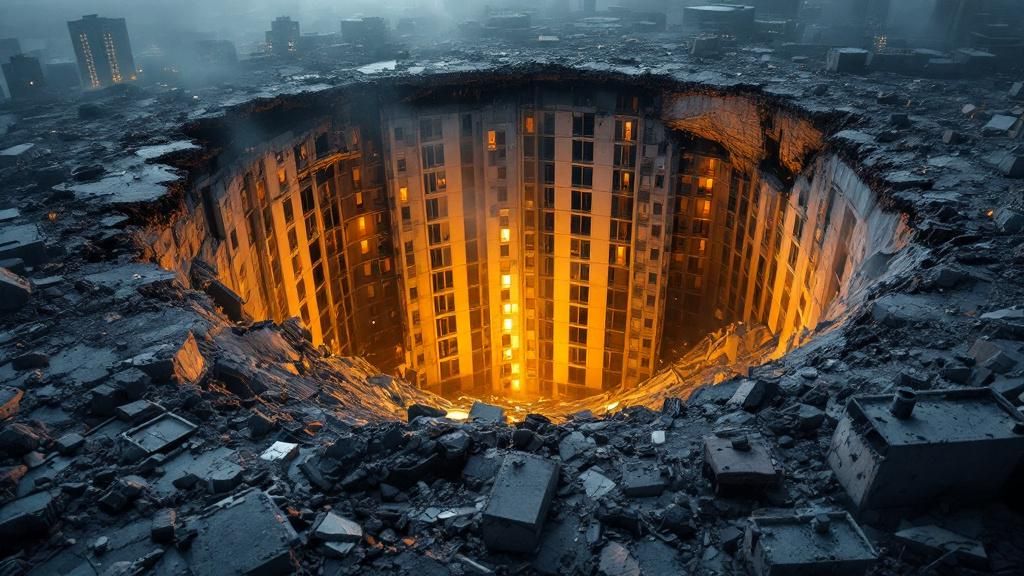
More than 160 people were hurt in Iranian ballistic missile strikes on two southern Israeli towns in proximity to a nuclear research facility, Israeli emergency officials confirmed. The attacks, which occurred late on Saturday evening, targeted the towns of Arad and Dimona, with 84 people undergoing treatment in Arad and a further 78 in Dimona. The missiles, which penetrated Israel’s sophisticated air defence systems, inflicted considerable damage to buildings in both locations. The strikes followed an earlier attack on Iran’s Natanz nuclear facility, as stated by Iranian state television. The International Atomic Energy Agency stated it is not aware of any damage to the Israeli nuclear research centre positioned roughly 13 kilometres outside Dimona.
The missile strikes and immediate fallout
Residents of Arad described the moment of impact as frightening, with witnesses noting intense explosions that shattered apartment blocks and left significant gouges in the town. Emergency medical technician Yakir Talkar portrayed the scene as “very severe,” noting that many of those hurt sustained multiple types of injuries. The Iranian ballistic missiles inflicted substantial structural damage, with several buildings badly damaged by the strikes. Photographs from the scene revealed the extent of the destruction, displaying destroyed portions of residential buildings and widespread debris spread across affected areas.
The neighbouring town of Dimona experienced a comparably severe aerial bombardment, with first responders struggling with the scale of wounded individuals requiring medical attention. Among those injured is a 10-year-old boy whose state has been described as serious by healthcare professionals. Israeli authorities have begun an inquiry into how the Iranian missiles successfully penetrated the nation’s advanced air defence systems. Israeli emergency responders verified that interceptors were activated in both towns but were unable to stop the hostile projectiles, leading to successful strikes from long-range missiles equipped with explosive devices weighing multiple hundred kilos.
- Missiles bypassed Israel’s advanced air defence systems on Saturday evening
- Multiple buildings suffered severe damage in both Arad and Dimona towns
- Emergency services treated over 160 injured across the two locations
- Israeli authorities examining how ballistic missiles evaded interception attempts
Air defence systems overloaded
The successful breakthrough of Israeli air defences by Iranian ballistic missiles has triggered immediate investigations into how the nation’s sophisticated defensive systems failed to prevent the strikes. Israeli officials acknowledged that interceptors were deployed in both Dimona and Arad, yet these defensive measures were ineffective against the approaching missiles. The failure constitutes a significant breach in Israel’s layered air defence system, which has traditionally been considered as amongst the most sophisticated in the world. Officials are now scrutinising the circumstances that allowed multiple ballistic missiles to strike their objectives unimpeded.
The implications of this defence breakdown go further than the direct loss of life and physical destruction. The capability of Iranian projectiles to penetrate Israel’s air defence network prompts significant concerns about the susceptibility of critical infrastructure, notably the nuclear research centre situated close to the strike zones. Israeli security experts are probably to perform comprehensive reviews of radar systems, interception protocols and reaction times. The incident underscores the evolving threat landscape in the Middle East, where opponents command cutting-edge weapons equipped to contest even advanced defensive technologies.
How the weapons pierced Israeli defensive positions
According to Israeli firefighters, interceptors were deployed in both locations but failed to neutralise the ballistic missile threats before impact. The missiles, carrying warheads weighing hundreds of kilograms, struck their targets despite defensive measures being activated. This suggests either insufficient interception capability, inadequate warning time, or operational constraints in the air defence system’s capacity to intercept multiple simultaneous threats. The specific technical reasons for the interception failures remain under investigation by Israeli military authorities.
The timing and direction of the Iranian strikes may have presented particular challenges to Israel’s defensive systems. Ballistic missiles follow predictable arcs but offer limited reaction time once detected. The vast quantity of missiles launched at once could have overwhelmed interception capacity, a tactic commonly employed to tax defensive infrastructure. Israeli officials have not yet disclosed specific details about the number of missiles launched or the particular defence systems deployed, citing security considerations during continued tensions.
The atomic dimension and mounting pressures
The Iranian missile strikes have taken on heightened significance owing to their closeness to the Shimon Peres Negev Nuclear Research Center, commonly known as the Dimona reactor. Located approximately 13 kilometres outside the town of Dimona, this facility constitutes the cornerstone of Israel’s nuclear deterrent and remains the only acknowledged nuclear weapons programme in the Middle East. The targeting of areas near such a strategically vital installation has alarmed Israeli officials and raised questions about Iran’s intentions. The International Atomic Energy Agency has confirmed no damage to the facility itself, yet the incident illustrates Iran’s willingness to strike at targets in close proximity to Israel’s most sensitive military infrastructure.
The attack represents a major intensification in the continuous pattern of tit-for-tat strikes between Israel and Iran. Iranian official media traced the missile strikes to an prior Israeli strike on Iran’s Natanz nuclear facility, also on Saturday. This retaliatory pattern illustrates the precarious balance between the two nations’ nuclear ambitions and the broader regional conflict. Both Israel and the United States have established preventing the development of Iranian nuclear weapons a key strategic priority, whilst Iran asserts its right to develop nuclear technology for peaceful purposes. The proximity of Saturday’s strikes to Israel’s nuclear research facility has intensified global anxiety about possible nuclear conflict in the Middle East.
Israel’s unacknowledged nuclear stockpile in jeopardy
Israel has maintained a policy of deliberate ambiguity regarding its nuclear weapons programme for approximately six decades. Whilst the official position asserts that the Dimona facility concentrates exclusively on nuclear research, it is widely accepted internationally that Israel developed and maintains an unacknowledged stockpile of atomic weapons at this facility. This strategic ambiguity has allowed Israel to retain nuclear capability as a deterrent whilst avoiding formal acknowledgement, a stance every successive Israeli government has rigorously upheld. The facility’s existence and purpose constitute an widely known fact in worldwide defence circles, yet the country’s refusal to confirm its nuclear weapons capability stands as a fundamental pillar of Israeli strategy.
The Iranian rocket strikes, though producing no confirmed damage to the nuclear installation proper, have exposed the susceptibility of this essential site to immediate assault. The accomplished breach of Israeli air defences by long-range projectiles suggests that even heavily fortified atomic installations cannot be regarded as fully protected against resolute opponents. This acknowledgement carries serious ramifications for Israel’s sustained defence approach and atomic policy. The event may lead Israel to reassess security arrangements around the Dimona facility and additional classified military facilities, possibly resulting in increased military expenditure and elevated geopolitical strain as protective systems are strengthened.
- Dimona reactor contains Israel’s undeclared nuclear weapons for approximately six decades
- International Atomic Energy Agency established no damage or radiation leakage from the site
- Iranian attack demonstrates weaknesses of nuclear sites to modern ballistic missile technology
Retaliatory atomic plant attacks
The Iranian ballistic missile strikes on Saturday night constitute a direct retaliation for an prior Israeli attack on Iran’s Natanz nuclear facility, marking a serious escalation in the cycle of reciprocal strikes of nuclear-linked military actions. Iran’s state television explicitly confirmed that the missile strike was launched in response to the Israeli strike, signalling a conscious decision to target facilities of equivalent strategic significance. This pattern of escalation demonstrates how quickly regional tensions can spiral when nuclear installations are used as military objectives. The readiness of both countries to strike at each other’s nuclear facilities raises alarming questions about the risk of severe miscalculation in an already volatile region where nuclear weapons capabilities are a central concern.
The exchange of attacks on nuclear facilities marks a substantial shift from earlier patterns of local tensions, where such sites were generally regarded as restricted areas due to the devastating civilian consequences of any radiological incident. Both Israel and Iran have now shown a willingness to violate this implicit agreement, though fortunately neither attack has caused reported harm to atomic facilities or radioactive release. Global analysts express serious worry that this precedent could encourage further strikes on atomic installations, possibly triggering an unmanaged atomic emergency. The International Atomic Energy Agency’s oversight function grows ever more critical as both countries continue military operations in proximity to critical atomic facilities.
| Facility | Recent activity |
|---|---|
| Shimon Peres Negev Nuclear Research Center (Dimona), Israel | Struck by Iranian ballistic missiles on Saturday evening; 78 people injured in nearby Dimona town; IAEA reports no damage or radiation leakage |
| Natanz Nuclear Facility, Iran | Attacked by Israel on Saturday; Iranian authorities report no radioactive material leakage or danger to public; IAEA confirms no increase in off-site radiation levels |
| Israeli air defence systems | Failed to intercept Iranian ballistic missiles; interceptors launched but missed targets, resulting in two direct hits with warheads weighing hundreds of kilograms |
| Regional nuclear escalation cycle | Represents unprecedented willingness by both nations to target each other’s nuclear infrastructure; raises international concerns about potential catastrophic miscalculation |
Global worries and broader implications
The strikes on atomic installations have prompted urgent diplomatic responses from world powers worried by the escalation trajectory. The International Atomic Energy Agency has intensified its surveillance operations, with officials emphasising the paramount importance of restraint near vulnerable atomic sites. Western nations have advocated de-escalation, cautioning that further attacks on nuclear sites could have severe regional consequences. The UN Security Council is likely to convene emergency sessions to respond to the crisis, with permanent members voicing concern at the example being created. International nuclear experts have advised that even a single radiological incident could leave vast areas uninhabitable and precipitate humanitarian crisis affecting millions across the Middle East.
The wider political ramifications reach well beyond the local area, raising questions about nuclear security protocols and global legal frameworks. Both nations have invoked valid safety worries, yet their willingness to breach the traditional sanctity of nuclear sites contradicts years of implicit understanding among atomic powers. This intensification jeopardises to fundamentally alter local balance of power and could encourage other nations to reassess their nuclear security strategies. Analysts warn that the cycle of tit-for-tat strikes risks spiralling beyond either side’s management, especially considering the involvement of proxy forces and the intricacy of contemporary warfare in heavily populated zones near essential installations.
