
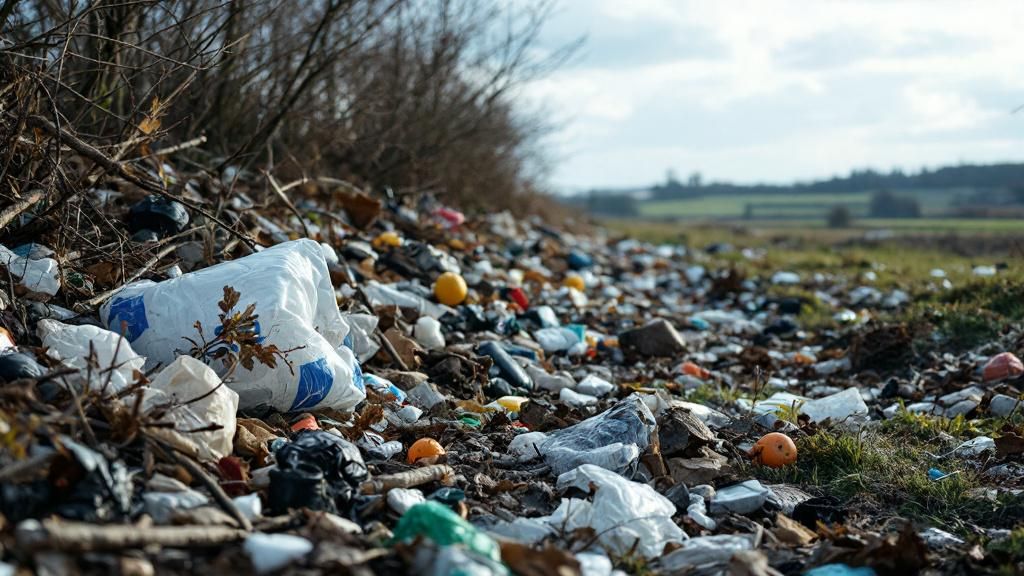
The government is considering granting Environment Agency officials police-style powers to tackle illegal waste dumping and fly-tipping across England. Under the new proposals, enforcement officers would be able to conduct searches of premises without a warrant, seize assets and apprehend individuals involved in waste crime. The announcement comes as government prepares to unveil their Waste Crime Action Plan next week, together with separate proposals that could see drivers penalised with penalty points if caught illegally dumping waste. Environment Secretary Emma Reynolds stated the government was “acting decisively” to “halt waste offenders” in their tracks and bring those responsible rapidly dealt with by courts. The new powers would be enacted through existing legislation including the Police and Criminal Evidence Act and the Proceeds of Crime Act 2002, with implementation contingent on parliamentary time becoming available.
Fresh enforcement powers for environmental enforcement staff
The Environment Agency’s compliance inspectors currently rely on conventional legal approaches to tackle waste crime, pursuing prosecutions in court with varying degrees of success. Last year alone, the agency secured 10 immediate custodial sentences and closed over 1,000 illegal waste sites active throughout England. However, government officials contend the agency’s performance has been hampered by limited investigative powers compared to police forces, rendering them incapable to investigate specific avenues or respond quickly against alleged perpetrators.
The planned expansion would substantially reshape how environment agency staff carry out investigations into waste crime. By gaining access to powers historically restricted to law enforcement, encompassing warrantless searches and asset seizure, the Environment Agency would be more effectively equipped to undermine criminal networks running illegal dumping sites. These new capabilities would permit officers to respond more rapidly and more decisively against fly-tippers, potentially preventing continued environmental deterioration and recovering costs connected to illegal waste disposal operations.
- Inspect premises without needing a warrant from magistrates
- Confiscate assets belonging to individuals suspected of waste crimes
- Apprehend people suspected of perpetrating offences related to waste
- Initiate prosecutions under the Proceeds of Crime Act
The extent of England’s waste crime issue
Fly-tipping has become an entrenched environmental crisis across England, with councils struggling to manage an unprecedented volume of illegal dumping incidents. According to the most recent official data covering 2024 to 2025, local authorities dealt with 1.26 million fly-tipping incidents throughout the year, representing a substantial strain on already stretched budgets. The overwhelming proportion of these cases, approximately 62 per cent, involved domestic refuse illegally deposited on land without appropriate authorisation. The enormous extent of the problem underscores why ministers consider tougher enforcement measures essential to stem the tide of ecological offences.
The spatial extent of illegal dumping operations reveals how deeply waste crime has permeated England’s landscape. Numerous unlicensed waste tips now function across the country, with investigators uncovering at least 11 exceptionally sizeable “super sites” where substantial volumes of waste accumulate unchecked. Some city regions face particularly acute problems, with certain cities recording more than 16 illegal dumping cases daily. This widespread criminality has prompted the government to determine that traditional regulatory approaches alone are inadequate to address the scale and complexity of contemporary waste trafficking operations.
| Metric | Figure |
|---|---|
| Fly-tipping incidents (2024-2025) | 1.26 million |
| Incidents involving household waste | 62% |
| Illegal waste sites shut down (last year) | Over 1,000 |
| Annual economic cost to tackle waste | Around £1 billion |
Financial burden on communities
The economic impact of fly-tipping extends far beyond the immediate cost of removing illegal dumping sites. The Environmental Services Association calculates that tackling waste crime costs the English economy approximately £1 billion each year, a figure that reflects removal work, environmental remediation, and reduced output. Local authorities bear the brunt of these costs, drawing funds from already constrained budgets that could otherwise fund essential services. This financial drain has prompted council officials to welcome any initiatives that might reduce the extent and prevalence of illegal dumping incidents in their regions.
Communities living in unauthorised dumping grounds face additional hidden costs over and above immediate remediation costs. Environmental pollution can compromise ground conditions, degrade aquatic environments, and create community health risks that necessitate professional remediation. Property values in affected areas often decline, whilst residents experience reduced quality of life due to visual blight and associated anti-social behaviour. The government’s decision to pursue tougher legal mechanisms reflects recognition that prevention through deterrence may ultimately prove considerably cheaper than continuously handling the repercussions of unchecked waste crime.
Reinforcing punishments and disincentives
The government’s multifaceted approach to tackling waste crime includes markedly increasing penalties for those caught engaging in illegal dumping activities. Under emerging regulatory frameworks currently being examined, individuals caught moving and handling waste illegally will face sentences of up to five years imprisonment, representing a significant increase from existing penalties. These toughened prison terms are designed to serve as a strong disincentive, signalling to potential offenders that waste crime carries grave repercussions comparable to other criminal enterprises. Environment Secretary Emma Reynolds emphasised the government’s commitment to “stop waste criminals in their tracks and bring those responsible swiftly to justice,” underscoring the administration’s commitment to improve enforcement outcomes.
Beyond imprisonment terms, the government is implementing complementary measures targeting motorists involved in illegal waste dumping. New proposals would enable drivers caught illegally dumping waste to receive penalty points on their driving records, reflecting the points system used for various driving violations. This approach proves particularly effective given that licence holders face potential disqualification from driving if they accrue twelve or more penalty points within three years. By connecting waste offences with driving entitlements, the government creates an additional layer of deterrent that impacts offenders’ daily lives and livelihoods, arguably becoming more immediately impactful than remote custodial terms for numerous offenders.
- Up to 5 years incarceration for unlawful waste haulage and dealing
- Penalty points on driving licenses for fly-tipping offences with possible disqualification
- Enhanced Environment Agency authority to search premises and confiscate proceeds of crime
What the Waste Crime Initiative is designed to deliver
The government’s planned Waste Crime Action Plan, set to be released next week, forms a thorough approach created to address the growing problem of illegal waste dumping in England. The plan expands on established enforcement frameworks whilst implementing innovative approaches to disrupt organised waste crime groups functioning on a large scale. By integrating increased legal capabilities with targeted deterrents, the programme seeks to challenge the economic incentives that make fly-tipping attractive to unscrupulous operators. The Environment Agency’s track record demonstrates the likelihood of success: in the past year alone, regulators obtained ten jail terms and closed more than one thousand unauthorised waste facilities. However, government ministers acknowledge that these achievements, although significant, constitute just a small part of the enforcement effort necessary to tackle an estimated one billion pounds in yearly financial costs.
The extent of the challenge continues to be significant, with councils in England handling 1.26 million illegal dumping cases during 2024 to 2025, of which sixty-two per cent comprised household waste. Some areas experience particularly acute difficulties, with certain cities documenting more than sixteen incidents daily. Illegal waste sites remain widespread, including eleven so-called “super sites” functioning across the country, many in remote regions where enforcement proves logistically challenging. The Waste Crime Action Plan confronts these locational differences and practical challenges by equipping enforcement officers with tools previously unavailable to them. Ministers contend that granting Environment Agency officials police-equivalent powers—including warrantless searches, asset seizure, and arrest powers—will dramatically improve their capability to investigate and prosecute waste criminals effectively.
Official dedication and timeframe
Environment Secretary Emma Reynolds has indicated the government’s unwavering commitment to introducing these transformative enforcement powers, stating that ministers are “implementing strong action” to address waste crime. The administration regards fly-tipping not merely as an environmental nuisance but as genuine criminal activity requiring equivalent enforcement action. Ministers propose to introduce statutory amendments enabling Environment Agency officials to operate under established legal structures including the Police and Criminal Evidence Act and the Proceeds of Crime Act 2002. This approach prevents lengthy new legislation whilst quickly broadening enforcement capabilities. Reynolds confirmed that the government would introduce these modifications “as parliamentary schedules permit,” indicating a realistic method balancing urgency with parliamentary timetabling demands.
The timing of these statements reveals overarching government priorities concerning environmental crime and health and safety safeguards. By launching the Waste Crime Action Plan in conjunction with announcements concerning strengthened enforcement capabilities and licence suspension measures, ministers showcase integrated policy-making combating fly-tipping from different enforcement mechanisms in parallel. This comprehensive approach acknowledges that no single measure proves adequate to remove waste crime; conversely, uniting imprisonment terms, driving disqualifications, confiscation capabilities, and warrantless search capabilities develops effective deterrent frameworks. The administration’s commitment to move quickly, limited solely by legislative timetables, suggests these measures may commence in the forthcoming legislative period, potentially transforming waste crime control mechanisms over a matter of months rather than years.
Industry perspective and current obstacles
Environmental organisations have long championed for strengthened enforcement measures to tackle fly-tipping, considering the proposed powers as a vital step forward in combating entrenched waste crime. The Environmental Services Association estimates that illegal waste dumping costs the English economy roughly £1 billion per year, a striking amount that demonstrates the scale of the problem. Keep Britain Tidy, the leading environmental charity, highlights that fly-tipping—defined as the illegal placement of waste on land without proper authorisation—places significant financial strain on local councils obliged to perform costly remediation work. These organisations have continually maintained that Environment Agency officials require law enforcement authority to successfully break up organised waste crime networks active across the country.
Despite ongoing enforcement efforts producing tangible results, the challenge remains formidable. Last year alone, the Environment Agency secured ten immediate custodial sentences and shut down over 1,000 illegal waste sites, showcasing operational success within current constraints. However, government figures show the sheer magnitude of the problem: councils in England dealt with 1.26 million fly-tipping incidents during 2024–2025, with household waste accounting for 62 per cent of reported cases. Hundreds of illegal waste tips continue operating nationwide, including eleven designated “super sites” representing particularly egregious environmental violations. These sobering statistics illustrate why the government believes stronger enforcement powers are essential, suggesting that existing legislative frameworks, whilst effective, cannot sufficiently tackle the systematic nature of modern waste crime operations.
