
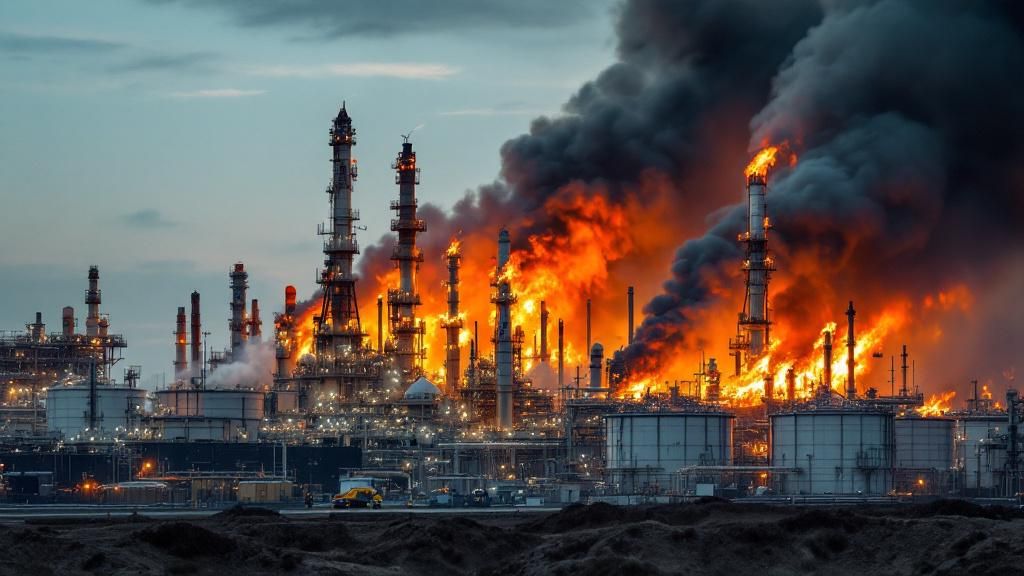
Global oil prices have climbed past $110 per barrel for the initial time in four years as escalating military conflict between the United States, Israel, and Iran could severely disrupt energy supplies from one of the world’s most vital shipping routes. Brent crude jumped nearly 24% to $114.74 on Monday morning, while American light sweet crude climbed over 26% to $114.78, fueled by fears of sustained disruptions through the Strait of Hormuz, which typically handles about one-fifth of the world’s oil supply. The spike resulted from fresh waves of US and Israeli airstrikes over the weekend that targeted multiple Iranian facilities, including key oil depots in Tehran. Stock markets across the Asia-Pacific region tumbled sharply in response, with Japan’s Nikkei 225 plunging more than 7% and South Korea’s Kospi triggering automatic trading halts as investors moved away from riskier assets.
Energy Crisis Unfolds in the Middle East
The escalating conflict has created an historic energy crisis as traffic through the Strait of Hormuz has nearly ground to a halt since fighting began a week ago. Approximately 20 percent of the world’s oil supply typically transits through this narrow waterway, making any interference with maritime traffic a major worry for worldwide fuel industries. The obstruction of this key waterway has stranded millions of barrels of crude oil and LNG in the Persian Gulf, with tankers reluctant or unable to pass through the increasingly dangerous route. This supply shock has rippled through international markets, triggering panic among traders and energy consumers globally.
Iran’s Sunday declaration that Mojtaba Khamenei would take over from his father Ali Khamenei as Supreme Leader signals that hardline groups remain firmly in control of the country, suggesting the tensions may escalate. The targeted destruction of Iran’s energy facilities, including major depots near Tehran, has compounded supply worries and sparked debate about the length of the disruption. Oil analysts alert that sustained curbs on passage through the Hormuz Strait could send oil prices to greater heights, with possible consequences for price levels, shipping expenses, and economic development across developed and developing economies.
- Strait of Hormuz traffic halted since conflict commenced 7 days ago
- Approximately 20% of worldwide oil production normally transits waterway
- Millions of barrels trapped in Persian Gulf unable to ship
- Iranian oil depots destroyed by weekend air raids, lowering production capacity
Stock Markets Fall Steeply Amid Supply Fears
Financial markets throughout the Asia-Pacific region faced severe turbulence on Monday morning as investors reacted to the intensifying Iran tensions and surging oil prices. Stock exchanges from Tokyo to Sydney saw sharp declines as traders rushed to exit positions in energy-sensitive sectors and higher-risk investments. The combination of geopolitical uncertainty and concerns about prolonged energy supply disruptions alarmed market participants worldwide, sparking a broad-based equity selloff. Major indices fell sharply within minutes of trading commencement, reflecting the speed at which risk sentiment deteriorated across the region as crude prices continued their relentless climb toward $115 per barrel.
The sharp declines emphasized investor apprehensions about the economic implications of sustained high energy prices. Escalating petroleum expenses risk drive up production expenses for manufacturers, raise transportation costs for businesses, and potentially set off broader price pressures across economies. Carriers, logistics firms, and energy-dependent sectors came under significant strain as traders foresaw margin squeeze and diminished earnings. The synchronized selloff across multiple markets revealed how closely linked global financial systems have become, with a localized energy shock rapidly converting to worldwide market instability and increased economic anxiety for multinational corporations.
| Market Index | Percentage Change |
|---|---|
| Japan Nikkei 225 | -7.0% |
| South Korea Kospi | -8.0% |
| Hong Kong Hang Seng | -3.0% |
| Australia ASX 200 | -4.0% |
| Brent Crude Oil | +24.0% |
Circuit Breakers Triggered
South Korea’s Kospi index activated automatic trading halts on Monday morning as panic selling accelerated, with the circuit breaker mechanism halting trading for two decades of minutes to reduce volatility. This market protection measure was activated for the second instance in three days, having earlier been triggered on Wednesday when the index fell 12%. Circuit breakers are intended to provide market participants with a pause during periods of extreme volatility, stopping cascading sell-offs driven purely by fear rather than underlying economic factors. The multiple triggers highlighted the degree of market stress and investor anxiety surrounding the financial consequences.
The introduction of these safeguard systems demonstrates exchanges’ recognition that markets require circuit breaks during periods of severe disruption. By pausing trading, regulators aim to allow investors an opportunity to review their holdings and incorporate emerging information before resuming transactions. However, the frequent triggering also points to fundamental market weakness and considerable concern about the how long the conflict will last and final effects on fuel supplies. Financial authorities throughout the region maintain watchfulness, ready to introduce additional support measures if trading conditions decline further.
The Hormuz Strait Bottleneck
The Strait of Hormuz, a narrow waterway between Iran and Oman, represents one of the world’s most vital energy bottlenecks. Roughly one-fifth of worldwide oil production normally transits through this crucial corridor, rendering it vital for international energy security. Since the start of conflict between the US, Israel, and Iran a week ago, traffic through the strait has essentially stopped. Tankers carrying crude oil and liquefied natural gas have either halted activities or rerouted to different passages, generating an unprecedented backlog of energy supplies unable to access international markets and risking severe shortages worldwide.
The closure of the Strait of Hormuz has surprised market participants despite analyst warnings who predicted such disruptions. Last week, market players appeared relatively complacent about the prospect of vast quantities of oil stuck in the Persian Gulf. However, aerial attacks conducted over the weekend hitting Iran’s energy facilities fundamentally changed market psychology, sparking the sudden surge in prices above $110 per barrel. The blend of constrained flows flowing through the strait and damaged production facilities across Iran has created a perfect storm for petroleum trading, forcing traders to recalculate availability projections and sending valuations up with unprecedented speed and volatility.
- One-fifth of the world’s oil reserves normally shipped through the narrow passage
- Traffic has largely stopped since conflict began one week ago
- Tankers diverted to alternative routes, creating unprecedented supply disruptions
Economic Ripple Effects and Future Prospects
The spike in oil prices above $110 per barrel carries profound implications for economies worldwide, extending far beyond energy markets. Increased oil expenses translate directly into increased expenses for transportation, manufacturing, and heating, ultimately raising inflation pressures on consumers and businesses. Central banks navigate a challenging balance between supporting economic growth and controlling price increases. The shock could disrupt the modest recovery many economies have experienced, particularly vulnerable developing nations dependent on energy imports. Airlines, shipping companies, and petrochemical manufacturers are already reviewing profit forecasts as input costs climb unexpectedly.
Looking ahead, the direction of oil prices depends critically on the conflict’s timeframe and whether additional infrastructure damage occurs. Energy specialists suggest prices could climb further if airstrikes intensify or if the Strait of Hormuz continues to be restricted for extended periods. Some analysts warn of conceivable $150-per-barrel scenarios if supply chain interruptions continue past a few weeks. Governments are exploring emergency reserves and substitute fuels to reduce effects. However, the fundamental unpredictability about Iran’s political trajectory and military capabilities keeps unsettling markets, making dependable projections extremely challenging for financial stakeholders and decision-makers alike.
Expert Forecasts and Regulatory Action
Financial institutions and energy analysts have issued conflicting assessments about oil’s trajectory, reflecting genuine uncertainty about peace agreement timelines. Goldman Sachs and other leading financial institutions initially predicted $100-per-barrel prices, but the rapid breach of $110 has prompted upward revisions. Some analysts now anticipate sustained elevated prices throughout 2026 if hostilities continue, while others suggest volatility will normalize once markets adjust to new supply realities. The speed of price movement—jumping 10% in a single minute—demonstrates how thin trading volumes and cautious investor behavior amplify price swings in energy markets.
Government measures have been rapid but restricted in scope. The Biden administration indicated willingness to draw from strategic petroleum reserves, a measure that could offer short-term assistance if implemented. Japan and South Korea declared urgent energy-saving measures and possible fuel subsidies to protect consumers. The European Union organized urgent sessions to coordinate energy policy responses. However, policymakers acknowledge that no single intervention can fully offset the supply shock if the Strait remains closed. International coordination will prove essential, as unilateral actions risk generating market distortions and competitive disadvantages across trading partners.
- Goldman Sachs revises forecasts higher amid unprecedented supply disruptions
- Emergency oil stockpile measures evaluated to maintain price levels in the short term
- Japan and South Korea implement urgent efficiency and financial assistance schemes
- International coordination critical to avoid price volatility and economic division
