
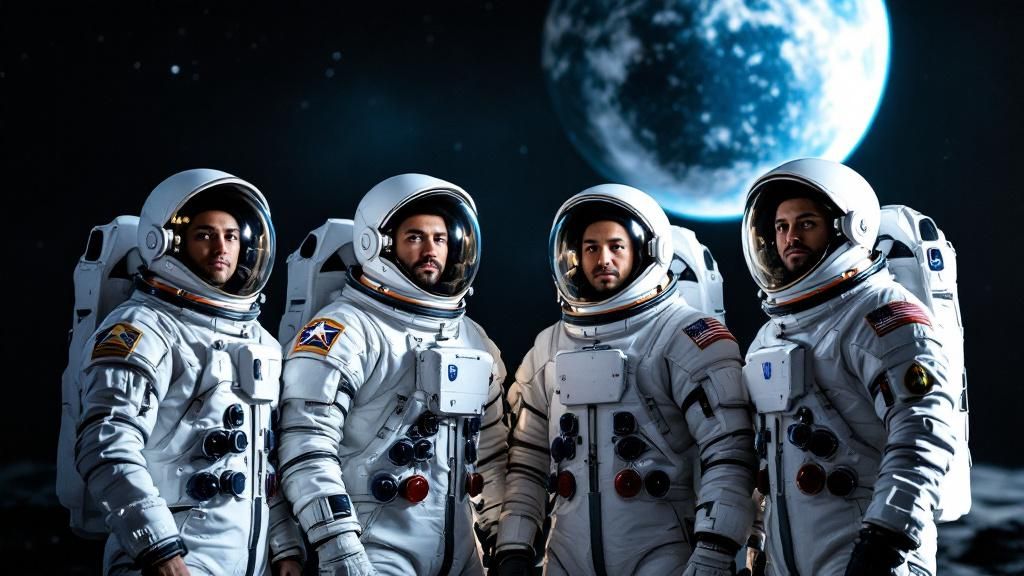
Four astronauts are getting ready for some of humanity’s most important space missions in recent decades, with their Artemis II spacecraft set to travel around the Moon for the first time since the Apollo era over five decades ago. Commander Reid Wiseman, along with fellow NASA astronauts Victor Glover and Christina Koch, plus Jeremy Hansen from the Canadian Space Agency, will soon undertake this historic journey. Beyond their impressive credentials as engineers, pilots and scientists, these accomplished professionals are also parents and partners navigating the profound personal dimensions of their mission. As they ready themselves for launch, each crew member has chosen meaningful personal items to carry with them on their journey around the Moon, objects that reflect both their individual characters and the deeply human stakes of their extraordinary adventure.
A Remarkable Crew Embarks on Flight
The Artemis II mission constitutes a watershed moment in human spaceflight, representing the initial manned moon orbit in over five decades. Commander Reid Wiseman, a US Navy experimental aviator who previously served as flight engineer on the International Space Station, will lead the expedition with distinctive modesty and intent. Wiseman, who was born in Baltimore, Maryland, has shown considerable fortitude in his personal life, raising two teenage daughters as a sole guardian after his wife’s cancer-related death in 2020. His approach to leadership combines his military training and his practical understanding of life’s unpredictability, candidly addressing matters of succession planning and contingencies with his family.
Alongside Wiseman are three remarkable space professionals whose collective knowledge spans engineering, physics, and international cooperation. Christina Koch, an physicist and engineer, holds the record for the longest single spaceflight by a woman, having completed 328 days aboard the International Space Station in 2019. Victor Glover and Jeremy Hansen of the CSA round out the team, each bringing their own distinguished backgrounds and individual drive to this groundbreaking mission. Together, they embody not merely a group of skilled pilots and researchers, but individuals deeply connected to their loved ones and local communities, transporting the hopes and dreams of their loved ones into the cosmos.
- Reid Wiseman will take a compact notebook to document his observations throughout the mission
- Christina Koch holds the record for longest single spaceflight among women at 328 days
- The crew comprises three NASA astronauts and one Canadian Space Agency member
- This mission is the first crewed lunar orbit in more than 50 years since the Apollo programme
Wiseman’s Authority and Silent Bravery
Reid Wiseman assumes his role as commander of Artemis II with a distinctive blend of military precision and genuine humility. Despite holding the title, he is at pains to highlight that this mission belongs to the entire crew, not to him alone. When reflecting on his teammates, Wiseman expresses clear admiration for Victor Glover, Christina Koch, and Jeremy Hansen, characterising them as keenly driven yet remarkably grounded. His approach to leadership seems rooted in recognising the combined capabilities of the team rather than casting himself in the sole driver of their success. This team-oriented mindset may well establish the pattern for how the crew tackles the significant obstacles that await them in the Moon’s orbit.
Wiseman’s individual path has given him a philosophical perspective on peril and human mortality that few people share. Having navigated the profound loss of his spouse’s death from cancer whilst raising two adolescents by himself, he has cultivated an stark candour about life’s fragility and uncertainty. Paradoxically, this person who dedicates his career undertaking remarkable achievements confesses to a anxiety about heights when standing on solid ground. This inconsistency reflects the multifaceted nature of his personality—a seasoned test pilot and cosmonaut who remains grounded in human frailty, refusing to pretend that courage means the absence of apprehension or hesitation.
Managing Leadership and Parenthood
The demands of preparing for a moon mission whilst raising adolescent daughters alone would overpower most people, yet Wiseman has framed this double obligation as both his “greatest challenge and the most rewarding phase” of his life. Rather than shielding his children from the harsh realities of his career, he has embraced candour. During a casual walk, he discussed with them the whereabouts of his will, trust documents, and contingency plans—conversations that many families avoid entirely. This strategy reflects his belief that honest dialogue about risk and uncertainty, rather than denial, is what genuinely readies families for the unexpected.
Wiseman’s openness about these difficult topics extends beyond his own household. He has expressed a wish that more families would take part in similar conversations about mortality, legacy, and preparedness. His perspective suggests that facing life’s uncertainties directly, rather than avoiding them, can strengthen familial bonds and offer genuine reassurance. As he embarks on this historic mission, his daughters will do so knowing that their father has confronted his anxieties head-on and prepared his household for whatever may come. This grounded wisdom may prove just as valuable as any technical expertise he brings to the Artemis II mission.
Koch Journey from Earthrise to Lunar Orbit
Christina Koch embodies a new generation of astronauts whose accomplishments have progressively broken long-standing limitations. As an physicist and engineer, she has demonstrated exceptional technical prowess across various fields, securing her position among NASA’s leading space explorers since her appointment in 2013. Her history-making 328-day spaceflight aboard the International Space Station in 2019 stands as the longest single mission by any woman in recorded time. Beyond this outstanding achievement of endurance, Koch participated in the inaugural all-women spacewalk, a achievement that represented the evolving diversity of human spaceflight and opened new possibilities for coming generations of female astronauts.
Now, as mission specialist for Artemis II, Koch will help pilot the spacecraft around the Moon, applying her extensive knowledge of orbital mechanics and spacecraft systems to this historic endeavour. Her journey from Earth to lunar orbit represents not merely a individual accomplishment, but a confirmation of the capabilities that women bring to space exploration. Born in Grand Rapids, Michigan, Koch exemplifies the scientific rigour and resolve required to extend the limits of human spaceflight, serving as an inspiration to many young individuals considering careers in aerospace and engineering.
Preserving Links Through the Expanse
Like her crewmates, Koch will be able to bring a personal item into space—a physical token of her earthbound connections during the human return to lunar orbit. These tiny keepsakes serve profound psychological purposes for astronauts, grounding them in their identities beyond their professional roles and sustaining connections to the people and places they hold dear. For Koch, this personal memento will travel 250,000 miles into the lunar environment, a physical embodiment of the human desire to convey purpose and recollection across the tremendous reaches of space.
The tradition of astronauts carrying personal belongings illustrates an core principle about space exploration: that even as we reach for the stars, we remain deeply linked to our origins on Earth and human bonds. Koch’s decision about what to bring will undoubtedly reflect her principles and concerns, whether celebrating family, celebrating a cherished memory, or preserving a emblem of motivation. These intimate choices bring humanity to the grand endeavour of Artemis II, helping us remember that behind the technical expertise and mission objectives exist real individuals with authentic relationships.
Hansen and Glover: Pioneering Fresh Territory
Jeremy Hansen of the Canadian Space Agency will establish a landmark as the first non-American to journey outside low Earth orbit, marking a significant milestone in global space collaboration. A ex-RCAF combat aviator, Hansen brings exceptional piloting skills and a genuine passion to advancing Canada’s role in space exploration. His selection highlights how Artemis II goes beyond national limits, bringing together the world’s space agencies in this bold journey to lunar orbit. Hansen’s presence aboard the spacecraft demonstrates the partnership approach essential for humanity’s further exploration of the cosmos and future missions to distant worlds.
Victor Glover, a US Navy pilot and engineer, will become the first Black astronaut to journey to the Moon, a significant milestone that underscores the evolving diversity within NASA’s astronaut corps. Glover had previously worked as a pilot on Expedition 64 and 65 aboard the International Space Station, developing crucial expertise in spacecraft operations and orbital mechanics. His participation in Artemis II constitutes not only a individual achievement but also a pivotal point for representation in space exploration. Glover’s expertise and determination exemplify the quality of talent now aiming for the lunar horizon.
- Hansen demonstrates Canada’s expanding role in space exploration activities beyond Earth orbit
- Glover will be the first Black astronaut to reach the Moon on Artemis II
- Both astronauts contribute military aviation expertise essential for spacecraft management
- Their selection reflects NASA’s focus on diversity and international cooperation
Mementos with Significance
Like their fellow crew members, Hansen and Glover have selected meaningful objects to travel with them on this momentous voyage around the Moon. These personal selections demonstrate the deep human desire to transport representations of family, home, and personal identity into the depths of space. The objects they bring will travel 250,000 miles from Earth, functioning as physical links to the individuals and locations they hold dear. For astronauts embarking on such remarkable expeditions, these small mementos provide emotional stability and emotional sustenance during the demands of space travel.
The custom of carrying personal items into space shows something core about human exploration: even as we journey into the cosmos, we remain deeply rooted in our earthly relationships and bonds. Whether commemorating family and friends, honouring cultural traditions, or bringing symbols of inspiration, these choices bring humanity to the technological accomplishment of Artemis II. Hansen and Glover’s picks will undoubtedly reflect their principles, goals, and the people who supported their journeys to this historic moment in space history.
What They’re Transporting Beyond Earth
| Astronaut | Personal Items |
|---|---|
| Reid Wiseman | A small notepad for jotting down thoughts during the mission |
| Christina Koch | Items reflecting her scientific achievements and personal connections |
| Victor Glover | Objects honouring his family and cultural heritage |
| Jeremy Hansen | Mementos representing Canada’s space exploration legacy |
| Artemis II Crew | Collective symbols of human connection and shared purpose |
NASA allows each astronaut to bring a limited selection of private belongings aboard the Orion spacecraft, a tradition honouring the deeply human aspects of space exploration. These carefully chosen objects—whether notebooks, photographs, or meaningful mementos—function as anchors to Earth during the extraordinary journey around the Moon. For Wiseman, a simple notepad becomes a means of recording significant instances and reflections. For his crewmates, their selections similarly represent the connections that support them through rigorous training and the fundamental dangers of spaceflight. These personal selections convert Artemis II from a strictly technical achievement into a deeply personal human endeavour.
