
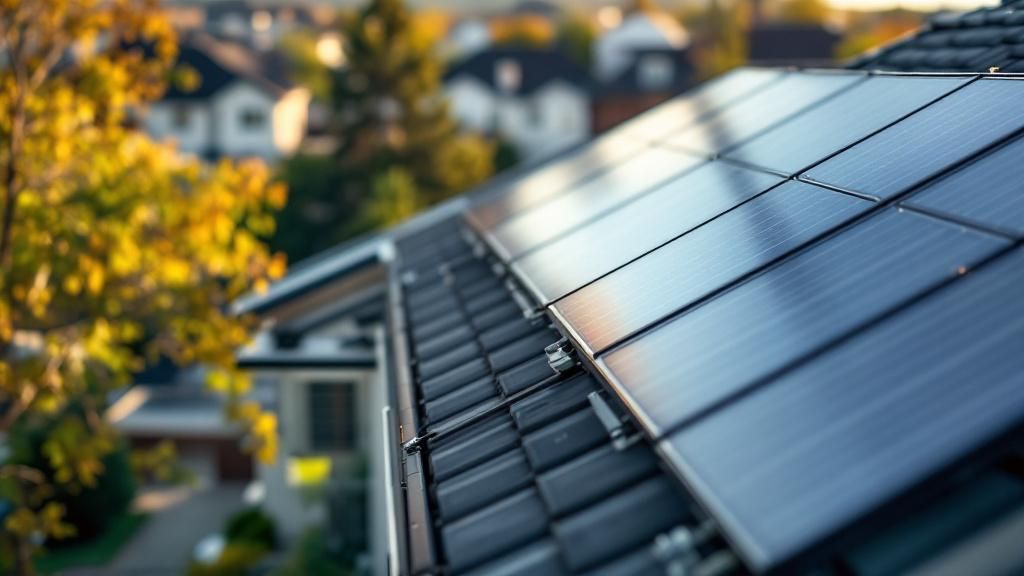
From 2028, all new homes constructed in England will be mandated to include solar panels and heat pumps fitted as standard, the government has announced. The revised planning standards, unveiled on Tuesday, represent a major change in building regulations aimed at accelerate the UK’s green energy transition. Under the updated regulations, newly constructed homes will no longer be connected to the gas network, instead depending on heat pumps or heat networks for heating. Solar panels must span approximately 40 per cent of the ground floor space. The move has been embraced by energy companies and green technology firms as providing essential market stability, though developers have raised concerns about the estimated £10,000 additional cost per home.
Required Green Technology for Future Homes
The Future Homes Standard, which has been in development for the previous decade, ultimately delivers clarity on how new residential properties in England are required to be built. From 2028 onwards, the requirements will significantly alter building techniques across the country. Every new home must include solar panels on rooftops, with the panels taking up 40 per cent of the ground floor area. This requirement constitutes a major change to present-day building codes, where solar panels are not mandatory for developers and homeowners.
Energy Secretary Ed Miliband framed the announcement within the context of energy independence, citing recent geopolitical tensions as justification for renewable energy is crucial to the UK. The government contends these policies will provide the market certainty that installers, manufacturers and builders require to deploy capital in sustainable technology systems. Garry Felgate, CEO of the MCS Foundation, which validates installers of renewable heating technologies, stressed that the guidance provided by the new standards will be key to developing a robust UK sector for these solutions.
- All new residential properties must have solar panels spanning 40 per cent ground floor area
- Heat networks or heat pump systems mandatory; no gas network connections permitted
- Changes projected to increase £10,000 to construction expenses per property
- Plug-in solar panels to become available in UK supermarkets soon
Rooftop Solar Panels Coming to UK Town Centres
The authorities has announced that plug-in solar panels will soon be available for buying in UK supermarkets, marking a notable change in how British households can obtain renewable energy technology. These portable, DIY-friendly panels represent a more accessible entry point into solar power generation for millions of people who may lack suitable roof space or face regulatory hurdles. The move opens up green technology adoption, allowing renters and flat dwellers to participate in the shift to renewable power without requiring professional installation or lasting structural changes.
Such plug-in solar systems have become widespread throughout Europe, where they have proven popular with consumers seeking flexibility and ease of installation. However, they have not previously been sold in the UK due to stringent safety regulations governing electrical installations. The government’s move to allow their sale represents a significant regulatory shift, lifting restrictions that have prevented this technology from entering the British market. Energy companies and environmental organisations have welcomed the move as a pragmatic way to speed up solar uptake above the legally required standards applied to newly constructed homes.
How Solar Plug-in Works
Plug-in solar panels are compact photovoltaic systems designed for installation on balconies, patios or other outdoor spaces without requiring structural modifications or professional electrical work. Users simply mount the panels, connect them to a standard household socket, and the system immediately begins generating electricity that feeds directly into the home’s electrical supply. This straightforward approach makes solar energy accessible to renters and those in flats where traditional rooftop installation is impractical or impossible, significantly expanding the potential market for domestic solar generation|household solar power generation.
Market Response and Operational Obstacles
The declaration of mandatory solar panels and heat pumps has generated differing views across the residential and energy industries. Whilst renewable energy firms and sustainability experts have generally supported the measures for offering market certainty and investment clarity, building companies have raised concerns about the practical and financial implications. The Home Builders Federation recognised the industry had received adequate forewarning but emphasised that the increased financial burden imposed by these fresh obligations are problematic at a time when the sector faces significant economic pressures. Nevertheless, trade representatives recognise that the 2028 implementation date provides sufficient time for manufacturers, installers and builders to prepare for the transition and increase production capacity accordingly.
Certification bodies and renewable energy experts have praised the government’s move for creating a stable, predictable market environment. Garry Felgate, CEO of the MCS Foundation, highlighted that the clarity offered by these compulsory standards will stimulate investment in manufacturing, installation infrastructure and workforce training across the renewable heating and solar sectors. This regulatory certainty is anticipated to reduce expenses through economies of scale, as suppliers ramp up production to meet the expected demand from several thousand newly built properties annually. However, concerns persist about whether the transition timeframe will be adequate to tackle supply chain constraints and ensure adequate training of qualified installers across all areas of England.
| Stakeholder | Position |
|---|---|
| Energy Companies (e.g., Octopus Energy) | Supportive – view decarbonising new housing stock as essential and beneficial |
| Home Builders Federation | Cautiously accepting – concerned about costs but acknowledge adequate forewarning given |
| MCS Foundation and Installers | Welcoming – appreciate market certainty and investment opportunities created |
| Green Technology Sector | Positive – view requirements as catalyst for manufacturing growth and cost reduction |
Cost Considerations for Development Teams
The government anticipates that the new requirements will contribute approximately £10,000 to the building expenses of each new home. Developers have flagged this supplementary outlay as a major issue, particularly given present market challenges affecting the housebuilding sector. However, officials maintain that these upfront costs will be balanced by sustained reductions in energy bills for homeowners, with potential savings growing considerably if properties are fitted with battery storage systems.
Energy Security and Long-term Savings
The government’s choice to mandate solar panels and heat pumps in newly built properties from 2028 is presented as a essential response to international energy security challenges. Energy Secretary Ed Miliband emphasised that ongoing geopolitical pressures, especially the Iran conflict, have shown the vulnerability of depending on fossil fuel markets beyond the UK’s control. By transitioning new residential properties to renewable energy sources and heat networks, the government seeks to protect British consumers from volatile international energy prices and cut reliance on imported gas. This strategic shift represents a sustained commitment in UK energy self-sufficiency and protection from future supply disruptions.
For homeowners, the economic advantages of these green technologies are expected to accumulate considerably over time. Although developers will absorb approximately £10,000 in supplementary construction outlays per property, occupants should see measurable reductions in their energy bills through reduced heating and power costs. These savings will be especially notable in homes equipped with battery storage systems, which enable occupants to save excess solar energy for use when rates are highest or when sunlight is unavailable. The overall consequence across millions of new homes could result in considerable cost reductions for households whilst simultaneously reducing the nation’s carbon emissions and energy demand.
- Heat pumps replace gas boilers, minimising reliance on fossil fuels
- Solar panels produce renewable electricity, decreasing household energy costs
- Battery storage optimises financial returns by allowing efficient energy consumption
