
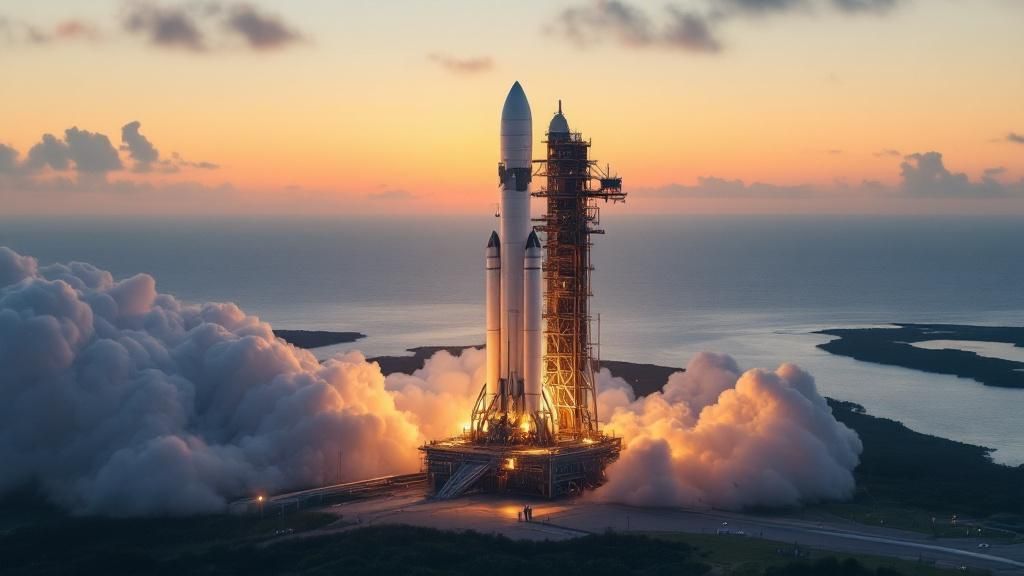
Nasa has identified early April as its planned launch date for the significant Artemis II mission, which will send four astronauts on a lunar orbit for the first time in over 50 years. The space organisation plans to move its mega Moon rocket back to the launchpad at Cape Canaveral, Florida, on 19 March, with 1 April set as the soonest launch date. The mission had previously been timetabled for March, but was deferred after engineers identified a helium leak in the Space Launch System rocket. Nasa leaders have now verified they are certain the problem has been resolved, enabling the groundbreaking 10-day journey that will have the crew orbit the far side of the Moon and come back.
The Long-Awaited Expedition Resumes
The Artemis II mission signifies a turning point for crewed space missions, highlighting humanity’s return to lunar exploration following a break exceeding five decades. The previous occasion astronauts travelled to the Moon was at the time of the Apollo 17 mission in December 1972, rendering this forthcoming mission a significant milestone in space exploration. The four-person crew—consisting of three American astronauts and one Canadian—will serve as the inaugural crew to fly aboard Nasa’s recently created Space Launch System rocket and the Orion spacecraft, both of which major technical improvements in deep-space exploration capacity.
Despite the setback caused by the helium leak, Nasa officials have demonstrated confidence in their ability to move forward. John Honeycutt, chair of the Artemis II Mission Management Team, recognised the built-in hazards whilst stressing the agency’s thorough process to identifying and managing risks. He noted that based on historical data, only 50 per cent of first-time rocket initiatives achieve success on their opening launch, but Nasa’s meticulous preparation and thorough knowledge of potential failure points position the mission favourably. The team has deliberately decided against conducting another pre-launch “wet dress rehearsal,” instead setting aside the following refuelling procedure for the actual launch attempt.
- Crew includes Reid Wiseman, Victor Glover, Christina Koch and Jeremy Hansen
- Mission length covers 10 days circling the lunar far side
- Vehicle Assembly Building operations proceed in parallel with launch pad readiness activities
- Launch readiness assessed by hardware performance and regular reviews
Tackling Technical Obstacles
The route to April’s liftoff has not been free from challenges, with engineers discovering a helium escape in the Space Launch System vehicle that required transporting the vehicle to the Vehicle Assembly Building at Cape Canaveral for comprehensive repairs. This setback compelled Nasa to postpone the original March launch window, a decision that underscores the organisation’s commitment to guaranteeing every component functions perfectly before risking the lives of four astronauts on such a significant mission. The identification and subsequent remediation of this issue demonstrates the careful precision needed when preparing humanity’s most sophisticated deep-space research craft for launch.
Nasa’s belief in addressed the helium leak issue has prompted officials to arrange the rocket’s return to the launchpad for 19 March, placing the agency for an soonest feasible launch date of 1 April. This timetable, whilst demanding, demonstrates the team’s assessment that the repairs have been comprehensive and effective. The determination to move forward demonstrates that despite the technical obstacle, the core systems and framework of the Space Launch System remain sound, and the agency’s technical team have effectively identified and corrected the fault without needing fundamental redesign or lengthy validation processes.
The Helium Leak Challenge
Helium serves a vital part within the Space Launch System’s engine configuration, serving as a pressure control mechanism that ensures structural soundness and facilitates correct fuel delivery during the vehicle’s operation. The leak identified during pre-launch checks represented a significant risk to mission objectives, as any degradation in the pressure control system could impact propulsion performance or flight stability during the critical ascent phase. The recognition of this fault, whilst initially disappointing, enabled engineers to tackle the issue methodically before it could compromise the mission, showcasing the efficacy of Nasa’s stringent pre-flight inspection processes and quality control measures.
The repair work performed in the Vehicle Assembly Building has reportedly rectified the helium leak to Nasa’s requirements, permitting the agency to advance with assurance toward the April launch timeframe. Officials have indicated they are satisfied with the remedial actions put in place, though they highlight that ongoing inspections and evaluations will remain ongoing throughout the preparation period. This measured approach—displaying confidence whilst maintaining vigilance—illustrates the mature engineering culture within Nasa, where accomplishment depends upon both decisive action and constant verification that all systems stay within acceptable operational bounds.
Introducing the Artemis II Crew
| Astronaut | Background |
|---|---|
| Reid Wiseman | US astronaut and mission commander, experienced in space operations |
| Victor Glover | US astronaut, bringing expertise in spacecraft systems and operations |
| Christina Koch | US astronaut with extensive experience in orbital missions and scientific research |
| Jeremy Hansen | Canadian astronaut, representing international partnership in lunar exploration |
| Artemis II Crew | First humans to fly aboard Nasa’s Space Launch System and Orion spacecraft |
The four-person crew selected for Artemis II constitutes a significant achievement in spaceflight history, denoting the first time that astronauts will travel past low Earth orbit since the Apollo programme ended over 50 years ago. Reid Wiseman, Victor Glover, and Christina Koch possess considerable expertise from prior missions, whilst Canadian astronaut Jeremy Hansen’s involvement highlights the spirit of international cooperation driving contemporary spaceflight. During their ten-day journey, these pioneering astronauts will navigate around the far side of the Moon—the hidden hemisphere constantly obscured from Earth—before coming back, laying the groundwork for forthcoming lunar missions and creating a permanent human presence on the Moon’s surface.
Managing Risk and Anticipated Outcomes
Nasa representatives have implemented a remarkably forthright approach when examining the intrinsic dangers connected to Artemis II, acknowledging that space exploration remains an intrinsically risky pursuit. John Honeycutt, chair of the Artemis II programme leadership team, delivered serious insight during the agency’s press briefing, pointing out that documented evidence on new rocket development reveals a stark reality: approximately merely 50 percent of freshly developed rockets achieve successful launches on their opening efforts. However, Honeycutt emphasised that Nasa’s rigorous engineering protocols and thorough risk evaluation processes position the Artemis II project in a substantially better footing than these previous standards would suggest.
The space agency has invested considerable effort into identifying, evaluating, and managing potential risk areas throughout the launch preparation phase. Rather than viewing risk as something to be eliminated entirely—an impossible goal in any complex engineering endeavour—Nasa’s approach prioritises identifying vulnerabilities, implementing protective measures, and establishing robust contingency controls. Officials highlighted that this methodical risk management philosophy, honed through extensive spaceflight history, represents the foundation for successful missions. The determination to eliminate additional pre-launch testing reflects trust in these mitigation strategies, with Nasa undertaking to launch only when all systems show operational capability.
What Could Go Wrong
- Equipment malfunctions in the Space Launch System rocket engines or load-bearing parts
- Software glitches or faults in the Orion spacecraft’s flight control and navigation systems
- Unexpected weather conditions hindering safe departure from Cape Canaveral, Florida
- Life support system malfunctions over the ten-day lunar journey and return
- Communication failures between ground control and the crew aboard the spacecraft
Moving Forward
Nasa’s timeline for Artemis II represents a carefully calibrated balance between drive and restraint. The space organisation plans to roll the Space Launch System rocket onto the launchpad at Cape Canaveral on 19 March, with an earliest feasible launch timeframe beginning 1 April. This schedule gives a buffer for final checks and any unforeseen complications that might emerge during the essential preparation phase. Officials have highlighted that whilst April stays as the planned month, the agency refuses to be pressured into launching early, with readiness for launch ultimately decided by the condition of the hardware rather than predetermined timelines.
Before Artemis II launches, Nasa engineers will finish outstanding tasks within the Vehicle Assembly Building and at the launch pad, examining all systems to maintain crew protection. The decision to skip another full-scale rehearsal—a full-scale fuelling and countdown simulation—demonstrates confidence that earlier testing has generated sufficient information. Lori Glaze, acting associate director for Exploration Systems Development, emphasised this practical approach, stating that the next instance of vehicle fuelling will be during an real launch attempt. This strategy demonstrates Nasa’s commitment to proceeding methodically whilst preserving achievable timelines for humanity’s return to lunar exploration.
