
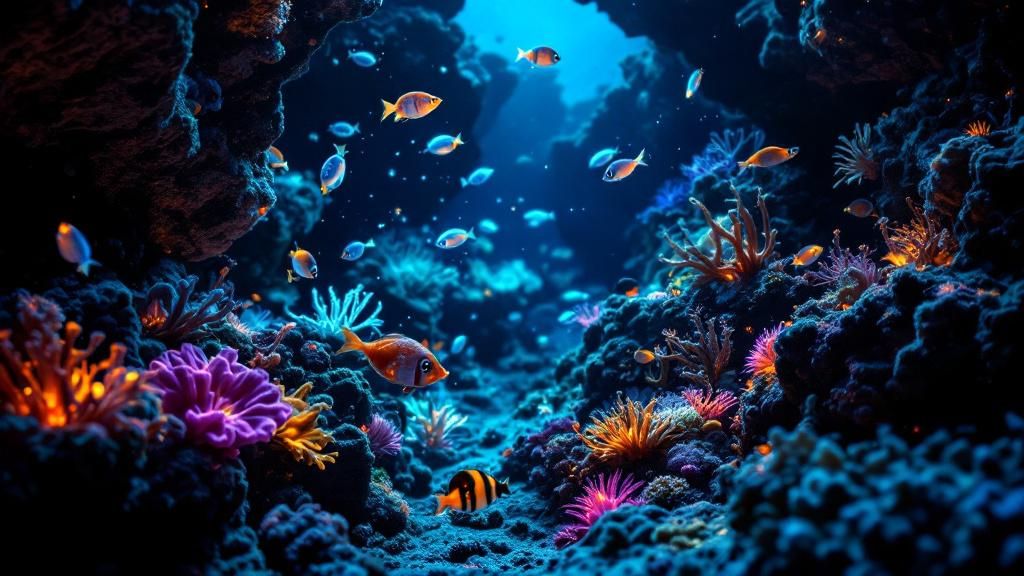
Researchers exploring the deep waters off Britain’s Caribbean possessions have discovered a concealed deep-sea environment teeming with never-before-seen creatures and untouched coral habitats. The groundbreaking expedition, running nonstop for six weeks off the Cayman Islands, Anguilla, and Turks and Caicos, has uncovered an submerged mountain chain, a massive “blue hole,” and coral formations apparently unaffected by climate change. Scientists from the UK Centre for Environment, Fisheries and Aquaculture Science (CEFAS) deployed imaging systems and instruments to depths of 6,000 meters, navigating treacherous waters using historical maps filled with inaccuracies. The discoveries mark the first systematic exploration of these remote deep-sea regions, with scientists already identifying mysterious new species, such as an unidentified swimming sea cucumber, and cataloging nearly 14,000 specimens that may increase the known biodiversity of these British Overseas Territories.
Pioneering Exploration Discovers Unknown Oceanic Worlds
The scientific voyage aboard the British research ship RSS James Cook constitutes a pivotal point in Caribbean ocean science. Operating continuously for six weeks, the team expanded the limits of ocean floor exploration, employing advanced imaging equipment and scientific instruments to endure the intense pressure of the seafloor environment. Professor James Bell, who headed the research effort in collaboration with scientists from the three island nations, emphasized the groundbreaking significance of their discoveries. “This is the initial foray into regions people have never seen, and in some cases were unaware of,” he stated, underscoring how large areas of the ocean floor stayed entirely unmapped due to outdated historical charts.
The researchers navigated using old navigation maps containing significant gaps and errors, yet their determination produced remarkable findings. Among the most remarkable finds was a strange swimming sea cucumber first confused with the rare “headless chicken monster” species. The team’s cameras recorded images of bizarre deep-sea creatures including enope squids, dragonfish, pelican eels, and barreleyes—organisms designed to endure in extreme conditions of darkness and pressure. Scientists are now working urgently to document and protect these fragile ecosystems before environmental degradation and contamination threaten their pristine state, recognizing that this deep-water realm represents one of Earth’s last truly unexplored frontiers.
- Researchers documented depths exceeding 6,000 meters using specialized equipment
- Underwater ridge system and large underwater sinkhole found off islands
- Nearly 14,000 specimens documented during the six-week mission
- Coral reefs observed seemingly untouched by climate change impacts
Significant Findings Reshape Understanding of Caribbean Ocean Ecosystems
Never-Before-Seen Creatures and Glowing Marvels
The expedition’s most remarkable discoveries involve creatures that have never been documented by science. Among the striking finds was an unnamed swimming sea cucumber that initially puzzled researchers, who momentarily believed it might be the elusive “headless chicken monster” species. The team documented unusual deep-sea creatures including enope squids, dragonfish with their characteristic large teeth, pelican eels displaying elongated forms, and barreleyes with transparent skulls and tubular eyes. These remarkable adaptations represent countless millennia of evolution in the planet’s most extreme conditions, where crushing pressure and absolute darkness define existence.
The variety of luminous organisms observed throughout the expedition exceeded scientists’ expectations. Many of the organisms discovered generate light through chemical reactions, using bioluminescence for communication, hunting, and defense in the constant darkness of the ocean depths. Professor James Bell expressed astonishment at the remarkable diversity encountered, describing the biodiversity as “really, really astonishing.” Each sample obtained adds crucial data to our comprehension of deep-sea ecology and may uncover novel biological mechanisms previously unknown to science, possibly providing insights relevant to medicine and biotechnology.
Aged Coral Ecosystems and Well-Preserved Reef Structures
Perhaps importantly, researchers discovered coral reefs that appear to have remained largely untouched by the devastating effects of climate change damaging shallow marine habitats worldwide. These deep-sea coral ecosystems represent ancient biological communities that have flourished in constant environments for centuries, developing intricate formations and sustaining specialized fauna found nowhere else on Earth. The corals recorded on the research mission display remarkable diversity, with species adapted to extreme cold, intense pressure, and scarce food sources. These discoveries highlight the vital necessity of protecting deep-water environments before human activities—including deep-sea mining and contamination—endanger their existence.
The team’s findings reveal that the Caribbean’s deep waters encircling British Overseas Territories contain some of the planet’s most pristine aquatic ecosystems. With up to 90 percent of Britain’s unique species present in these territories, the expedition has dramatically expanded the documented species diversity of the region. The 146 native species previously identified in the Cayman Islands, Anguilla, and Turks and Caicos will expected to rise substantially following analysis of the approximately 14,000 specimens collected. Scientists now highlight the critical importance for extensive conservation measures to safeguard these irreplaceable ecosystems from emerging threats.
Mapping the Unexplored Subaquatic Terrain
The expedition’s most core challenge was traversing waters that stayed largely uncharted and poorly documented. Researchers uncovered that existing nautical charts of the Caribbean territories held significant errors and entire regions absent in official records. This cartographic deficit forced the research group to rely on equipment and expertise well exceeding standard navigation tools, essentially charting previously unknown underwater terrain in real time. The discoveries included an underwater mountain range and a massive “blue hole”—geological features that fundamentally reshape our understanding of the region’s bathymetry and geological history.
Running nonstop for six weeks, the research vessel RSS James Cook deployed cameras and sensors capable of withstanding extreme water pressure at depths extending to 6,000 meters. The team’s systematic mapping approach uncovered a complex underwater landscape far more complicated than expected. These newly documented features deliver essential information for comprehending ocean circulation patterns, nutrient distribution, and habitat connectivity across the deep Caribbean. The comprehensive survey constitutes the first detailed examination of these waters and creates a foundation for future scientific research and environmental monitoring initiatives.
| Geographic Feature | Key Finding |
|---|---|
| Underwater Mountain Range | Discovered off Caribbean islands, representing previously unknown geological structures |
| Blue Hole Formation | Massive submarine sinkhole documented for the first time in the region |
| Deep-Water Basins | Surveyed to depths of 6,000 meters with complex topography |
| Coral Reef Systems | Mapped across multiple depth zones, showing pristine conditions |
The Complexity of Abyssal Mapping
Deep-sea cartography introduces significant operational and technical obstacles that have historically limited exploration of the Caribbean’s underwater realm. Decades-old nautical maps included critical errors and gaps in data, forcing researchers to navigate largely by sensor data and real-time sonar data. The extreme pressure at these depths demands specialized equipment designed to recording high-resolution imagery and environmental data simultaneously. This undertaking demonstrates how modern technology enables scientists to overcome conventional limitations and systematically document formerly unreachable marine environments with remarkable detail and exactness.
Climate Refuge and Conservation Impacts
The identification of coral reefs that appear remarkably untouched by global warming presents a rare glimmer of hope for aquatic preservation efforts. These unspoiled environments, prospering at depths where temperature swings are slight, may act as natural refugia for coral species confronting warming waters in shallower regions. Scientists view these deep-water communities as precious research sites for studying coral resilience and adaptation mechanisms. The findings underscore the vital necessity of protecting these isolated areas before anthropogenic impacts—including deep-sea mining, fishing, and contamination—can threaten their integrity and scientific value.
With up to 90% of Britain’s unique species concentrated in waters around its Overseas Territories, the environmental importance are extraordinarily high. The expedition has discovered 146 species not found anywhere on Earth within the Cayman Islands, Anguilla, and Turks and Caicos alone. Researchers highlight that swift safeguarding steps must be established to preserve these freshly identified ecosystems from growing dangers. The UK government, sharing responsibility for these territories’ ecological management, now faces mounting pressure to set up broad marine protected areas before environmental degradation and overexploitation can permanently harm these irreplaceable biological treasures.
- Establish protected marine areas around newly mapped deep-sea environments right away
- Monitor effects of climate change on pristine coral communities at depth
- Restrict mining and fishing activities in sensitive marine zones
Community Groups and Future Protection Initiatives
The expedition’s accomplishments depended substantially on partnership with scientists from the Cayman Islands, Anguilla, and Turks and Caicos, making certain that local expertise and environmental priorities informed the research direction. These island communities have consistently acknowledged the ecological significance of their surrounding waters, and the partnership between international researchers and local experts reinforces the scientific foundation for future conservation initiatives. By including Caribbean scientists in every stage of discovery, the project develops local expertise and encourages responsibility of these marine resources. This collaborative approach guarantees that protection strategies will be rooted in both scientific evidence and local knowledge, establishing more effective and culturally appropriate conservation frameworks.
Moving forward, researchers highlight that protecting these newly discovered ecosystems requires urgent action and sustained commitment from governments and international bodies. The UK government must work alongside island authorities to establish extensive marine protected areas that restrict destructive activities such as deep-sea mining and industrial fishing. Scientists are currently developing subsequent research missions to monitor environmental changes and document additional species. Community education efforts targeting local communities will raise awareness about the international importance of their waters, potentially transforming these territories into pioneers in ocean conservation and responsible marine stewardship.
