
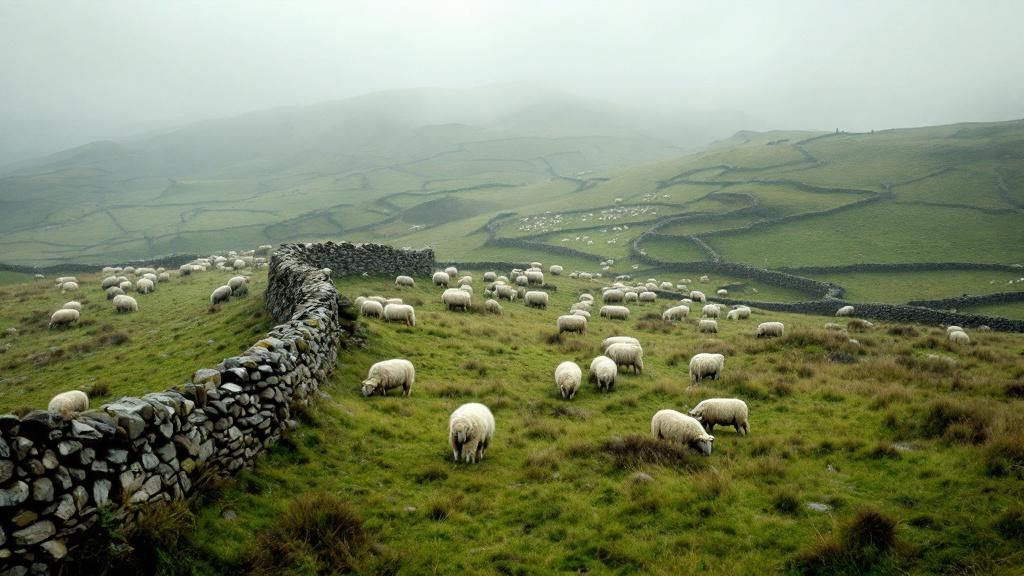
Britain’s livestock farming industry is experiencing its most significant change in generations, with flocks shrinking to levels not seen since the 1950s. The number of breeding sheep has dropped to 14.7 million—the lowest number in living memory—while the overall national flock has fallen to 30.4 million sheep in 2025. The crisis is transforming rural landscapes across the country, from the Yorkshire Dales to upland farms nationwide, as producers grapple with soaring costs, dwindling subsidies, and intense competition from overseas imports. Meanwhile, British appetite for lamb and mutton has collapsed, with household consumption dropping from 128 grams per person weekly in 1980 to just 23 grams today, forcing farmers to make difficult choices about the future prospects of their operations and the countryside itself.
The Dramatic Decline of Sheep Across British Farms
The transformation of Britain’s pastoral livestock landscape is clearly demonstrated by the experience of Hill Top Farm in Yorkshire’s Malhamdale, where the Heseltine family has worked the land for four generations. Once home to over 800 breeding sheep at its peak, the 1,500-acre holding now maintains just 45 breeding females. Neil Heseltine describes the shift as a “complete turnaround” driven by economic necessity rather than choice, acknowledging that without such dramatic changes, the farm’s financial viability would have been greatly undermined. His decision to shift away from sheep farming reflects a wider trend sweeping across Britain’s highland areas, where age-old farming practices faces mounting challenges.
The difficulties confronting sheep farmers are multifaceted and growing. The average British farmer is now 60 years old, according to the NFU, and must contend with elevated prices across energy, feed, and operational outlays. At the same time, state support have diminished significantly, straining extremely narrow profit margins. Perhaps most damaging are the latest trade arrangements with New Zealand and Australia, which abolished barriers and granted these countries large shares for lamb sales into the UK market. This flood of budget international products has made it increasingly difficult for UK producers to sustain profitable business at current price points.
- Breeding ewes dropped to 14.7 million, the lowest level ever recorded
- National flock decreased to 30.4 million sheep in 2025
- Lamb consumption decreased from 128g to 23g weekly per person
- Trade deals with Australia and New Zealand increased overseas competition
Bridging Heritage and Change
Sheep farming has been central to Britain’s rural identity and landscape for centuries, shaping the distinctive character of regions like the Yorkshire Dales. The iconic drystone walls that traverse these uplands were built specifically to keep livestock, while the rolling green hills owe their appearance to seasonal pasturing maintained by generations of shepherds. This heritage represents far more than agricultural tradition—it embodies a manner of living deeply connected to the land and communities. Yet this same landscape is now facing fundamental questions about its future use and purpose as farming economics create hard choices.
The strain between preserving agricultural traditions and adapting to contemporary conditions has become more pronounced. While many hill farmers continue to maintain sheep on their land, the economic case for large-scale sheep farming has substantially declined. Some are considering whether certain hill regions might be better utilized for different uses, such as supporting ecosystem recovery or other land uses that could deliver improved economic returns. These conversations represent not nostalgia but pragmatism—farmers and policymakers grappling with how to sustain farming communities while recognizing that the sheep production of earlier times may no longer be viable.
Financial Strain Forcing Farmers to Exit Sheep
The economic sustainability of sheep production in Britain has declined sharply over recent decades, compelling farmers throughout the nation to make difficult decisions about their businesses. Neil Heseltine’s work with Hill Top Farm in the Yorkshire Dales exemplifies this wider problem—his family reduced their breeding flock from over 800 sheep to just 45 in spring, a transformation driven by financial pressure rather than choice. As Heseltine notes, persisting in sheep farming purely out of sentimentality would have been economically ruinous. This change reflects a stark reality: the life of a traditional shepherd, never easy, has become progressively unsustainable as a primary income source for many rural families.
The structural obstacles facing sheep farmers go well past individual farm management choices. The average British farmer is now 60 years old, according to the NFU, and many are operating in an environment of significantly reduced income from farming support. Simultaneously, input costs have skyrocketed, with prices for fuel, fodder, and necessary inputs increasing significantly in recent years. These accumulating challenges have occurred alongside reduced consumer demand for sheep meat and greater competition from lower-cost imported lamb and mutton. For many farmers, the economics of sheep farming no longer works, irrespective of their dedication to the industry or their generational legacy.
| Year | Consumption per Person Weekly |
|---|---|
| 1980 | 128g |
| 2000 | 85g |
| 2010 | 45g |
| 2024 | 23g |
Rising Costs and Declining Revenue
British farmers encounter an unprecedented affordability challenge that has significantly transformed the economics of ovine farming. Fodder costs, fuel expenses, and veterinary costs have all increased substantially, reducing already-thin profit margins. Simultaneously, farmers have faced significant reductions in financial support, which historically delivered crucial income support. These twin pressures—escalating expenses paired with shrinking government support—have made it extremely difficult for many operations to sustain profitability at current market prices for lamb and sheep meat.
The circumstances has been worsened by newly negotiated trade deals that have flooded the British market with lower-cost imported lamb. The removal of trade barriers with Australia and New Zealand has provided producers in those countries significant trading allowances into the UK, depressing domestic prices. Farmers working in upland regions, where operating expenses are naturally higher due to difficult geographical conditions, have been particularly hard hit. Many are now wondering if they can afford to continue sheep farming at all.
- Grant payments have declined considerably since Brexit implementation
- Feed and fuel costs have increased dramatically over the past few years
- International competitors undercuts domestic lamb prices markedly
Changing Consumer Tastes and Worldwide Competition
The decline in sheep farming demonstrates a core change in British dietary choices that has emerged over decades. In 1980, the typical British family ate 128 grams of sheep meat per person weekly—a figure that has fallen to just 23 grams in 2024. This substantial 82% drop in eating means fewer people are purchasing lamb and mutton for their kitchens, substantially damaging the market that maintains upland farmers. The eating and lifestyle changes that have caused this decline appear mostly permanent, leaving farmers to grapple with a declining home market for their chief commodity.
Beyond changing tastes, farmers now compete in an increasingly globalized market where they are unable to match the prices of foreign suppliers. Australia and New Zealand benefit from reduced production expenses due to their favorable climate and abundant land, allowing them to undersell British farmers even before latest trade arrangements. The mix of lower consumer demand and worldwide price competition has created a ideal conditions for the UK sheep farming industry. Many farmers argue they simply cannot survive in this market conditions, forcing difficult decisions about whether to maintain sheep production or move into other farming options.
Trade Deals and Tariff Pressures
Britain’s post-Brexit trade agreements with Australia and New Zealand have significantly transformed the competitive landscape for UK sheep farming operations. These deals abolished tariffs on overseas lamb and mutton products while providing both countries substantial export quotas into the UK market. The rapid increase of cheaper overseas lamb has depressed domestic prices, making it progressively harder for British farmers to reach acceptable profit levels. Upland farmers, whose operating expenses are naturally elevated due to difficult geographical terrain and adverse weather, have been disproportionately affected by this new competitive pressure.
The effect of these commercial agreements extends beyond direct price pressures. They signal a movement toward UK agricultural direction toward unrestricted trade rather than domestic producer protection, a break with the state support framework that previously sustained sheep farming. Farmers argue they were not adequately consulted or compensated for the move into this new trading environment. Without trade barriers or financial support to compensate for the price disadvantage, many hill farming businesses that have persisted for years now encounter an unpredictable outlook in an highly competitive global market.
- Australia and New Zealand shipments get large quotas into British market
- Duty removal allows lower-cost foreign lamb to undermine British pricing
- Trade deals favor free market competition over protection of local farmers
Government Financial Support Move Away from Animal Agriculture
For a long time, state financial support made up the economic foundation of British sheep farming, offering predictable income that reduced the core obstacles of highland farming operations. However, the Brexit-era agricultural funding framework has significantly transformed these payments, moving away from direct payments linked to animal counts. Farmers like Neil Heseltine now obtain markedly diminished income from these established payment schemes, forcing them to develop additional revenue channels or stop raising sheep completely. This change has happened in tandem with growing production expenses in fuel, feed, and labour, generating strain that several highland enterprises are unable to withstand without major overhaul.
The shift in subsidy allocation indicates a more comprehensive policy reorientation toward environmental management rather than production-focused assistance. Under the updated approach, farmers are increasingly incentivized to care for land for ecological preservation, wildlife habitat, and emissions reduction rather than increase animal production. While these environmental goals deserve consideration, the changeover phase has left many traditional sheep farmers caught between reduced animal earnings and unpredictable alternative subsidies. Without sufficient transitional support during this overhaul, numerous independent holdings risk shutting down or compulsory operational shifts, endangering both countryside economies and the traditional countryside that has defined Britain’s uplands for centuries.
Updated Green Focus in Support Schemes
The government’s reformed subsidy system clearly emphasizes environmental outcomes over farming yields, rewarding farmers for wildlife habitat improvement, woodland establishment, and wildlife conservation rather than livestock farming. This strategic reorientation constitutes a significant departure from the conventional system of supporting food production through subsidy transfers. Farmers taking part in new environmental schemes receive payments based on farming methods that enhance natural environments, freshwater standards, and greenhouse gas reduction. However, these new payment rates often fail to match the income previously generated from livestock subsidies, leaving many farmers financially worse off despite adherence to environmental requirements.
The transition to environmentally-oriented subsidies has created uncertainty for upland farmers accustomed to production-based support. Many struggle to understand about long-term payment levels under the new schemes and have difficulty planning spending on environmental improvements without secure financial returns. Newer entrants, already disheartened by falling sheep profitability, experience even deeper hesitation about entering an industry with such unpredictable support mechanisms. The gap between environmental objectives ambitions and farming financial viability could increase rural depopulation and leave upland areas to either rewilding or neglect, contingent on how policy evolves.
- Subsidies now reward environmental protection and species diversity over animal farming
- Ecological support funds typically fall short than former agricultural support levels
- Concerns regarding long-term payment rates deters agricultural investment
- Emerging agricultural operators increasingly reluctant to enter sheep farming under new system
Habitat Restoration Versus Farming Tradition
The reduction of sheep farming has opened a contested debate about the long-term prospects of Britain’s highland landscapes. For centuries, livestock farming has shaped the distinctive character of regions like the Yorkshire Dales, forming the rolling green hills and patchwork of drystone walls that define these areas. Yet environmental scientists argue that these identical areas, shaped by intensive livestock management, have damaged biodiversity and ecological wellbeing. The tension between preserving agricultural heritage and recovering wild ecosystems has become increasingly difficult to reconcile, forcing policymakers and farmers to tackle core issues about land use priorities and what constitutes responsible stewardship of Britain’s countryside.
Some environmental advocates view the reduction in sheep farming as an opportunity to rehabilitate upland ecosystems harmed by centuries of grazing pressure. They point to research that lowering livestock populations allows native vegetation to recover, enhances water conditions, and provides space for animal populations. However, agricultural sectors worry that prioritizing nature recovery over food output will eliminate rural livelihoods and transform working landscapes into wilderness. This ideological conflict reflects broader societal questions about whether uplands should mainly support food production, environmental protection, or recreational use, and which groups should gain from decisions about land management in these economically marginal regions.
Evidence from Habitat Restoration Projects
Several rewilding programmes across Britain have demonstrated measurable ecological benefits from decreasing or eliminating sheep grazing in highland regions. Projects in the Scottish Highlands, English Lakes, and Peak District have recorded expanded plant species range, recovery of native tree species, and growth in bird and mammal populations following lower livestock intensity. These successes have generated government funding and wildlife charity support, facilitating growth of rewilding programmes. However, participating farmers often report significant income losses during implementation phases, and surrounding populations raise worries about job losses and altered visual character.
The Knepp Estate in West Sussex demonstrates one of Britain’s most celebrated rewilding examples, illustrating that former farmland can support vibrant wildlife communities and create additional revenue through tourist activities and ecological funding. Similar projects across upland regions demonstrate potential for habitat rehabilitation, yet rolling out such initiatives nationwide requires considerable capital commitment and agricultural community participation. Success depends on closing the divide between conservation ambitions and agricultural sustainability, making certain that nature recovery doesn’t simply neglect agricultural regions to financial hardship while transforming their landscapes.
- Conservation restoration projects show greater species diversity and native vegetation recovery within five years
- Participating farmers face income losses during transition to conservation management
- Conservation incentives and tourism revenue offer alternative income but rarely match previous agricultural returns
Finding Equilibrium Between Farming and Conservation
The decrease of sheep farming creates an unexpected opportunity for conservation initiatives across Britain’s uplands, yet the shift remains disputed among stakeholders with conflicting views for countryside management. Farmers argue that decades of sheep grazing have formed the unique terrain people cherish, from the Yorkshire Dales to the Scottish Borders. Conservation groups argue that decreasing animal numbers would enable native woodlands to recover and wildlife populations to recover, potentially generating new business prospects through eco-tourism and payments for carbon storage. This core dispute reflects broader concerns about whose interests should determine Britain’s countryside and whether food production or habitat restoration should take priority.
Finding workable solutions requires moving beyond polarized positions to create integrated approaches that support both rural livelihoods and environmental goals. Some farmers are experimenting with mixed-use models, combining lower livestock populations with environmental grazing agreements, tree planting, and varied business ventures like agritourism. Government support through environmental stewardship schemes and financial assistance for change could help additional landowners make comparable changes without experiencing economic hardship. Success depends on understanding that farming communities possess invaluable knowledge about landscape stewardship and deserve meaningful input into conservation decisions affecting their lands and livelihoods.
